
Ford Plastic Surgery
410-7 St Thomas Street
Toronto, ON M5S 2B7
Phone: (416) 925-7337
Monday–Friday: 8:30 a.m.–4:30 p.m.
Breast Augmentation in Toronto
In Toronto, Dr. Derek Ford, Dr. Steven Hanna, and Dr. Laura Snell specialize in breast augmentation for women who want larger, shapelier breasts that still maintain a natural appearance. Dr. Ford, Dr. Hanna, and Dr. Snell are Royal College-certified plastic surgeons who perform more than 300 breast procedures each year. The advanced techniques and leading-edge surgical options he offers make his practice one of the region’s top destinations for breast enhancement. Here, learn more about their approach and get a better sense of the variety of options you have at Ford Plastic Surgery.
Breast Augmentation
Before & After Photos
This gallery contains images intended for adult audiences.
VIEW PHOTOSHow Much Does Breast Augmentation Cost in the Toronto Area?
At our Toronto practice, breast augmentation cost depends on the type of implant you choose and the complexity of your procedure.
For procedure pricing, please visit our Pricing & Financing page.
*Prices exclude taxes
The surgeons at Ford Plastic Surgery’s advanced techniques and leading-edge surgical options make this practice one of the region’s top destinations for breast enhancement.
Calculate Your Payment
What Is Breast Augmentation Surgery?
Breast augmentation reshapes and adds fullness to breasts that naturally lack volume or have lost volume after pregnancy or weight loss. The procedure also balances asymmetrical breasts or provides improved shape and volume to tuberous breasts.
How To Choose the Best Toronto Area Breast Augmentation Surgeon for You
When you choose the right surgeon, you can relax and enjoy your plastic surgery journey. Things to consider for optimal safety and exceptional results include:
- Royal-college certification
- Bedside manner
- Experience performing breast augmentation
- Before and after photos
- Positive patient reviews
Each of our plastic surgeons meets these requirements, making them some of the best choices for breast enhancement surgery in the Toronto area.
Your Breast Augmentation Options
Breast augmentation is one of the most popular procedures at our practice; in fact, our surgeons perform more than 300 surgical breast procedures each year. Because each woman has her own individual goals and anatomical considerations, our surgeons offer a variety of breast implant choices and several different surgical options for completely customising surgical breast augmentation. During each consultation, your surgeon carefully evaluates each patient’s unique desires to help her build the perfect breast augmentation.
Which Type of Breast Implant Is the Best?
Your surgeon will review the following options to help you choose the breast implants that are best for you:
- Silicone breast implants are the most commonly used breast implants among our Toronto patients and in the U.S.1 Our surgeons offer round silicone implants.
- Saline breast implants are made of durable silicone shells filled with sterile saltwater.
In certain cases, our surgeons perform hybrid breast augmentation, which combines implants and fat grafting.
Implant Placement: Over the Muscle vs. Under
In addition to implant type, implant placement plays a significant role in the appearance and feel of your breast augmentation. Breast implants may be placed over the muscle (subglandular) or under the muscle (submuscular), depending on your anatomy, goals, and lifestyle.
Over the muscle (subglandular placement)
- Can offer a shorter recovery time and less post-operative discomfort
- May allow for easier muscle engagement for physically active patients
- Works best for patients with adequate natural breast tissue to provide coverage over the implant
Under the muscle (submuscular placement)
- Often provides more soft-tissue coverage, which can create a smoother, more natural transition
- May reduce the visibility or palpability of the implant in thinner patients
- Can slightly lengthen recovery due to muscle involvement
Because implant placement affects aesthetics, recovery, and long-term results, this decision is best made during an in-person consultation. Your surgeon will evaluate your anatomy and discuss your goals to recommend the approach that offers the safest and most aesthetically pleasing outcome.
Fat Transfer Breast Augmentation
Fat transfer breast augmentation uses excess fat from your body to enhance breast volume, offering a more natural alternative to implants with a modest increase in size. Fat is gently harvested from donor areas—such as the lower abdomen, thighs, or back—using liposuction. This offers the added benefit of refining and contouring these areas. Because the procedure depends on available donor fat, it is best suited to patients with sufficient fat who are seeking subtle, natural-looking enhancement.
Our surgeons can increase breast volume by transferring the harvested, purified fat. Because not all fat survives the transfer process, the resulting increase in size is generally more modest than what implants can achieve. In certain cases, fat grafting may also be used alongside implants to help camouflage them in patients with thinner tissue.
At Ford Plastic Surgery, our extensive experience in both liposuction and breast procedures supports precise technique and thoughtful planning to achieve balanced, natural-looking results.
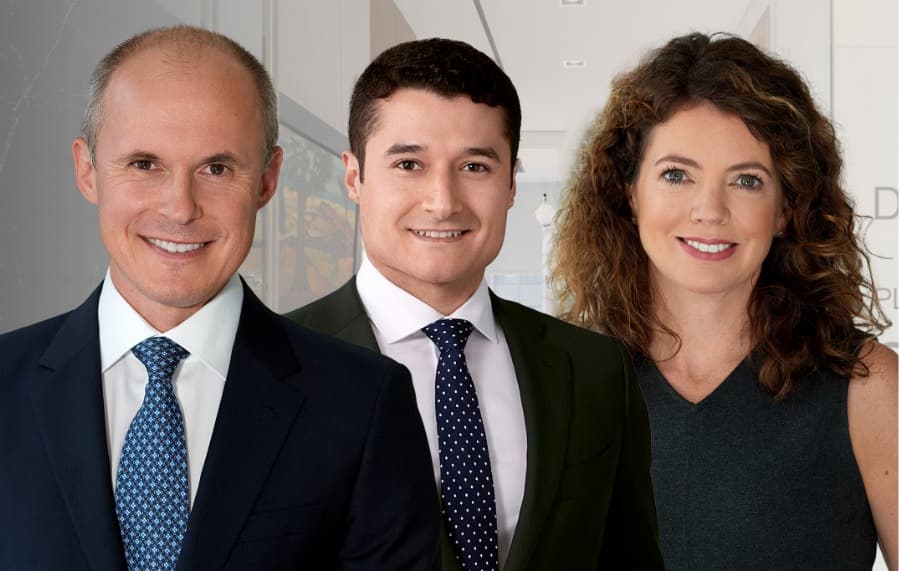
A Talented Trio
With their expertise in plastic surgery, Dr. Derek Ford, Dr. Steven Hanna, and Dr. Laura Snell create attractive, natural-looking results using advanced techniques. Each are Fellows of the Royal College of Physicians and Surgeons of Canada who provide compassionate patient care.
Learn more about our surgeons
Meet Dr. Derek Ford Meet Dr. Steven Hanna Meet Dr. Laura SnellYour Breast Augmentation Assessment
For most patients, the goal of breast augmentation is to improve both the size and shape of their breasts while maintaining a natural appearance. During the initial consultation, your surgeon uses Crisalix 3-D imaging software to allow you to virtually “try on” different sizes and styles of implants. This program helps both you and your surgeon accurately envision your potential results and work together toward the same goal.
Breast Augmentation vs. Breast Lift Surgery
Breast augmentation adds volume to the breasts, but it cannot address significant sagging. A breast lift, a procedure technically called mastopexy, repositions drooping breast tissue to create a more youthful shape and silhouette. Patients who are happy with the size of their breasts but are concerned about downturned nipples and sagginess are best suited for a stand-alone breast lift. However, mastopexy and breast augmentation can be performed together to improve the size, shape, and position of the breasts. This combined approach typically yields a full, perky, youthful-looking result.
Commonly Combined Procedures
In addition to breast lift surgery, our surgeons often combine breast augmentation with one or more of the following procedures for a mommy makeover:
Inverted Nipple Correction
Many women are bothered by the appearance of inverted nipples. While the condition is unlikely to resolve on its own, it is fairly simple to correct with surgery. Inverted nipple correction can be performed on its own under local anesthesia or in conjunction with breast augmentation or another breast enhancement surgery. When performed on its own, it requires very little downtime and creates a virtually undetectable scar.

See What’s Possible
Our practice offers Crisalix, a way for patients to preview their results in 3-D. This adds a tangible, visual element to your planning process, giving you and Dr. Ford a common, beautiful goal.
Learn MoreYour Breast Augmentation Procedure
Breast augmentation is performed while you are under general anesthesia. Your surgeon begins by making an incision either around the lower edge of your areola (called the periareolar incision) or along the crease beneath your breast (called the inframammary incision). You and your surgeon determine your incision location during your consultation.
Once he has made the incision, he creates a pocket within your breast tissue. Depending on your preferences, this may be above or below your chest muscle. He then adds the implant. While silicone implants are added whole, saline implants are inserted empty and filled once they’re in place, enabling your surgeon to use a relatively small incision. He evaluates the implants for symmetry before closing the incisions.
How Long Does It Take To Recover From Breast Augmentation?
Today’s techniques allow for a relatively comfortable and brief recuperation after breast augmentation. It’s important to carefully follow your surgeon’s directions for caring for yourself after surgery. You will also likely need to wear a soft surgical bra as your surgeon recommends.
Recovery Milestones
Here is a general timeline of recovery milestones (individual experiences may vary):
- Ready to shower: 48 hours after surgery
- Discomfort peaks: 3 to 5 days
- Remove sutures and dressings: 5 to 7 days
- Return to work, school, and nonstrenuous activities: about a week
- Bruising and swelling fade: 3 to 4 weeks
- Light exercise: Gentle, low-impact activity may typically resume around 4 to 6 weeks, depending on healing and surgeon approval
- Safe to go in a hot tub, swimming pool, the ocean: 3 weeks
- Implants soften and settle: 6 to 12 weeks
- Strenuous exercise: High-impact workouts, heavy lifting, and upper-body strength training are usually postponed until about 8 weeks
- Attain final results: 6 to 12 weeks
- Scars fade: At least 6 to 12 months
Your surgeon will guide you through each phase of recovery and let you know when it’s safe to gradually increase activity based on how your body is healing.
When Can I Exercise After Breast Augmentation?
While gentle walking is encouraged the week of surgery, you will need to wait about 2 weeks before resuming light, non-impact cardio workouts on a stationary bike, treadmill, stair machine, or other equipment. You will likely need to refrain from heavy lifting and vigorous activities for at least several weeks. Additionally, upper body exercise is discouraged until your chest muscles have fully healed. At your follow-up appointments, your surgeon will gradually clear you to resume certain activities.
What Are the Risks of Breast Augmentation?
As one of the most popular elective procedures in the world, breast augmentation is quite safe. However, no surgery is completely free of risk. In general, potential risks of breast augmentation include infection, excessive bleeding, development of excess scar tissue, and implant malposition. However, these are uncommon, especially when choosing a qualified plastic surgeon, such as Dr. Ford, Dr. Hanna, or Dr. Snell. During your consultation, your surgeon reviews your individual risk assessment with you to help you better understand how the surgery may affect you.
Breast Augmentation FAQ
Is breast augmentation safe?
In the hands of a well-qualified and experienced plastic surgeon, breast augmentation is generally considered very safe for patients who are in good health and don’t smoke (or who are willing to abstain before and after the surgery). Still, like any surgery, it does present some risk for complications such as capsular contracture and infection.
Will my breast augmentation look natural?
Results can look and feel very natural when implant size, material, shape, and placement are carefully selected to fit your body and the surgery is performed by an experienced, qualified plastic surgeon like Dr. Ford, Dr. Hanna, or Dr. Snell.
Will I need to replace my breast implants?
If you are happy with the way your breasts look and feel, you do not need to replace your implants. Dr. Snell offers revisionary breast augmentation to correct complications and replace implants with a different size or type (elective implant exchange), if your preferences change.
Will I lose sensation in my nipples after this surgery?
It’s not likely. Temporary changes in nipple sensation—such as numbness, partial loss of sensation, and hypersensitivity—are common after breast augmentation, but these issues usually resolve as the nerves heal. Nerve recovery can take a couple of months up to 18 months. In rare cases, sensation changes may be permanent.
When can I sleep on my side after breast augmentation?
Three weeks is considered safe. In the first two weeks, the surgical site is fragile and consistent pressure may displace the implant from the ideal position. After three weeks, the healing tissue (breast capsule) around the implant is more established, and it continues to strengthen over the next six weeks.
Is it better to get a breast lift or augmentation?
The best procedure depends on your primary concern. Breast augmentation is best for increasing size and fullness, while breast lift surgery reduces sagging and repositioning the breasts and nipples. Many patients benefit from a combination of both procedures for enhanced breast size, shape, and position on the chest.
How long do breast implants last?
Although breast implants are not designed to last a lifetime, they are very durable, and you can expect them to last 10 to 20 years.
Can you remove breast implants without replacing them?
Yes. Dr. Snell performs explant surgery for patients who want their implants removed without replacement.
If you think your breasts could use some added fullness, request a consultation online with one of our breast augmentation surgeons at our Toronto office or call (416) 925-7337 to schedule your appointment.
1 American Society of Plastic Surgeons, 2017 Plastic Surgery Statistics Report, https://www.plasticsurgery.org/documents/News/Statistics/2017/plastic-surgery-statistics-full-report-2017.pdf
2 Coleman, Sydney R. et al.,Primary Breast Augmentation with Fat Grafting , Clinics in Plastic Surgery, 2015 Jul;42(3):301-6, vii. doi: 10.1016/j.cps.2015.03.010.
https://www.plasticsurgery.theclinics.com/article/S0094-1298(15)00023-1/abstract