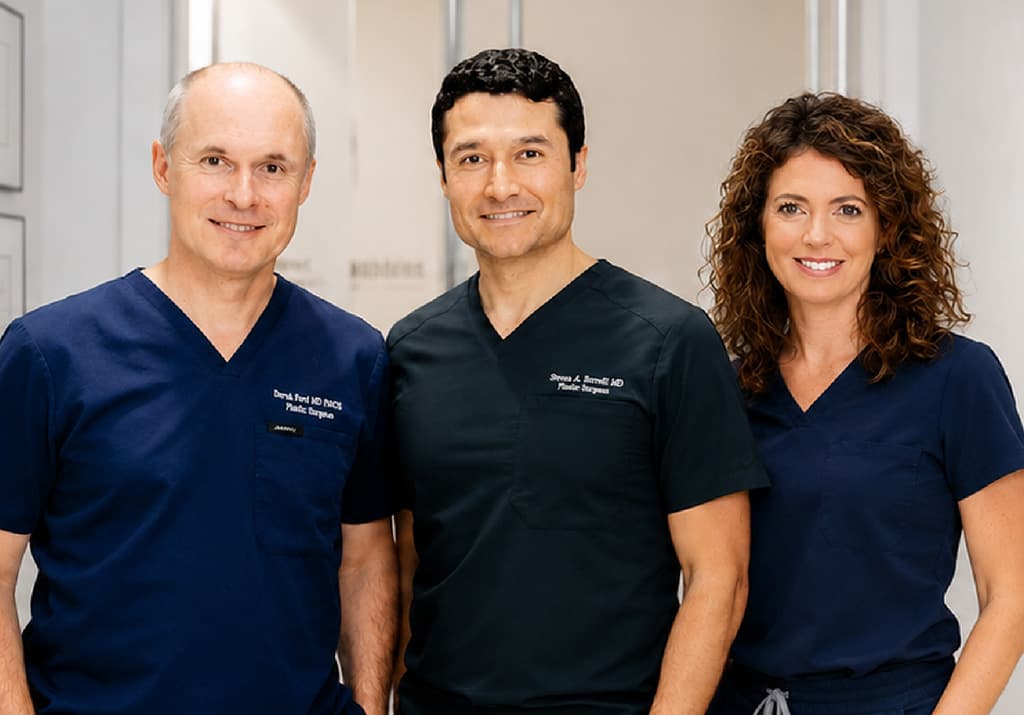
For men with gynecomastia (enlarged breast tissue and/or nipples), Royal College-certified plastic surgeons Dr. Derek Ford, Dr. Steven Hanna, and Dr. Laura Snell perform gynecomastia surgery to give Toronto patients a flatter, more masculine looking chest. Gynecomastia — which is not uncommon — often causes a great deal of embarrassment for those affected, making them self-conscious during exercise, intimacy, and other routine activities. Through a straightforward outpatient procedure, our surgeons help these men feel more confident and experience a better quality of life.
Gynecomastia is a relatively common condition that’s characterized by firm, glandular breast tissue under the nipple and areola, as well as fatty tissue over the chest. Although the condition has many potential causes, including certain medical conditions and medications, most are relatively harmless and not indicative of a systemic issue. Gynecomastia surgery, also called male breast reduction, is generally a much more straightforward procedure than its female counterpart. Most procedures can be performed primarily with liposuction through a small incision on the lower portion of the areola. This approach ensures very discreet scarring and a relatively brief recuperation process.
During your consultation, your surgeon examines your chest and reviews your medical history with you. In some cases, you may need to undergo additional testing to determine if there is an underlying medical condition contributing to your gynecomastia. Together, you develop a surgical plan to meet your goals. Your surgeon helps you understand the likely details of your recuperation, as well.
A TalentedTrio
With their expertise in plastic surgery, Dr. Derek Ford, Dr. Steven Hanna, and Dr. Laura Snell create attractive, natural-looking results using advanced techniques. All are Fellows of the Royal College of Physicians and Surgeons of Canada who provide compassionate patient care.
Gynecomastia surgery is performed as an outpatient procedure, which means you’ll be able to return home with the help of a friend or loved one soon after your surgery. During the procedure, your surgeon makes a small incision on the lower portion of your areola — the area of dark skin that surrounds the nipple. He uses liposuction to selectively remove the fat deposits causing the appearance of breasts. While most patients achieve good results with liposuction alone, patients with excess skin who are at risk of post-procedure sagging may require skin excision. This procedure can be performed at the same time as breast reduction surgery.
Recuperating After Surgery
Recuperation following male breast reduction is relatively straightforward and comfortable. You can expect to be back to work within about a week. While you are resting at home, it’s important to avoid strenuous activity including heavy lifting. It’s important to follow your surgeon’s guidelines for this time to ensure that your chest heals quickly and without complication. When you return to work, you will likely need to wear a compression band to support your chest as it continues to heal. This band can be comfortably concealed beneath your everyday clothes. Other precautions to take include avoiding unprotected sun exposure, as this can cause unnecessary scarring.
The results are generally long-lasting, provided the gynecomastia is not related to a medical condition.
Envision Your New Look
Our practice offers Crisalix, a way for patients to preview their results in 3D. This adds a tangible, visual element to your planning process, giving you and your plastic surgeon a common, beautiful goal.
Male breast reduction is usually performed as a solitary procedure, although it can occasionally be complemented by liposuction of the abdomen or flanks for a more proportionate result. If you wish to undergo more than one procedure during your surgery, you and your surgeon will discuss your wishes during your consultation.
There are many causes of gynecomastia. Some of the common ones include significant weight fluctuation, hormonal imbalances, and use of certain medications.
How is male breast fat removed?
Male breast fat is typically removed through liposuction or excision during gynecomastia surgery, depending on the amount and nature of the tissue.
Is gynecomastia surgery covered by OHIP?
Male breast reduction surgery is often performed using liposuction for chest contouring, and that component of the procedure is not covered by OHIP. Gland excision alone may be covered; however, liposuction is often combined with gland excision to achieve the best chest contour.
Is male breast reduction surgery performed under general anesthesia?
Our surgeons place incisions carefully to ensure scars are very discreet. Few people notice them once healed, and you will not need to change your hairstyle to hide them.
How long do I have to wear a compression garment after gynecomastia surgery?
Heavier compression vests are recommended for the first two weeks following surgery, followed by a lighter compression shirt for an additional 2–4 weeks.
What is recovery from gynecomastia surgery like?
The majority of swelling dissipates within 3–6 weeks. Bruising is typically present for 2–3 weeks. Patients may resume light activity after 2 weeks and unrestricted activity after 4–6 weeks.
What are male breast reduction scars like?
There is a small liposuction incision, measuring 3–5 mm, in the lower outer aspect of the chest. Occasionally, there is an incision along the inferior border of the areola. Both incisions typically heal to a very fine, faint line within 6–12 months.